

Make / Model Search
News - XpengXPeng eyes future beyond carsFive-model offensive to spearhead AI, autonomous driving, flying cars, energy tech for XPeng22 Jul 2026 By MATT BROGAN MEET George Jetson, his flying car, and Rosie the robot…
Yes, it seems gravity-defying transportation and robotised home help are no longer the vision of a 1960s cartoons series, but a close-to-production reality Chinese manufacturer XPeng says will be with us “well before the decade is out”.
Showcasing these technologies and others in Melbourne this week, the electric vehicle brand said the future of its Australian presence will include not only five new models over the next six months, but a broad, and somewhat ambitious strategy that will also introduce autonomous driving capabilities, ultra-fast charging, vehicle-to-grid technology, and both extended-range electric and range-extended electric vehicles to local buyers.
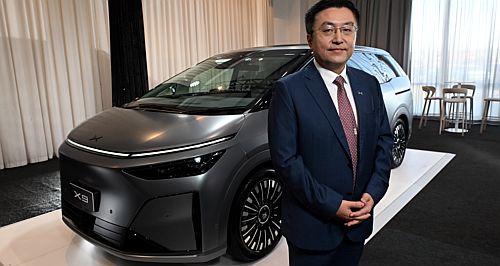
Speaking at the company’s Australian brand relaunch in Melbourne this week, XPeng vice chairman and president Dr Brian Gu said Australia would become the company’s “southern hemisphere home”, positioning it as a key market for the brand’s international expansion and among the first outside China to receive its latest products and mobility technologies.
The strategy, branded Ultimate Tech, reflects XPeng’s belief that future automotive leadership will be determined not by electrification alone, but by intelligence.
“We started with the belief that the ultimate differentiation for future mobility is not defined by electrification – it’s actually going to be defined by intelligence,” announced Dr Gu.
Central to the Australian roll-out is a commitment to launch five new-generation vehicles across multiple market segments while giving local buyers access to new platforms, software, and powertrain technologies in line with Chinese-market releases rather than years later.
The accelerated roll-out is intended to position Australia alongside XPeng’s leading international markets as the company expands beyond its domestic base.
Among the headline technologies earmarked for Australia is XPeng’s XNGP intelligent driving system, with the company targeting a local introduction before the end of next year, subject to regulatory approval.
The Level 2+ driver assistance system is already widely used in China, where XPeng says more than half of owners of compatible vehicles (50.2 per cent) rely upon it during everyday driving.
Selected Australian media sampled the system in Guangzhou earlier this year, where it demonstrated the ability to negotiate dense urban traffic, complex intersections, and multi-lane roads with minimal driver intervention.
XPeng also confirmed plans to introduce its latest ultra-fast charging ecosystem to Australia, pairing next-generation vehicles with dedicated high-output charging infrastructure based around its 800-volt electrical architecture.
The company was among the first manufacturers to commercialise an 800V production platform with the launch of the G9 in 2022, enabling substantially faster DC charging than conventional EV systems.
Recognising Australia’s unique driving conditions, XPeng will also introduce extended-range electric vehicles to complement its battery-electric line-up, offering an alternative for motorists regularly travelling longer regional distances.
The company further confirmed plans for an Australian vehicle-to-grid (V2G) pilot program, allowing compatible vehicles to return stored energy to homes and, ultimately, the electricity grid.
“Discussions with local partners are already underway ahead of further announcements on participating vehicles and rollout timing,” added Dr Gu.
Beyond its vehicle line-up, XPeng intends Australia to become an early international market for technologies developed under its broader Physical AI program.
These include the Iron humanoid robot, initially destined for dealerships and commercial applications, and the company’s modular flying vehicle, with Australia identified as a priority export market once Chinese certification and local regulatory approvals are complete.
Despite outlining an expansive technology roadmap, Dr Gu said the company’s ambitions extended beyond simply importing vehicles.
“Bringing XPeng to Australia is not enough. Building XPeng in Australia, and for Australia, is what we want to achieve,” he said.
The Melbourne showcase follows a similar preview in Munich, Germany, last week where XPeng founder and chief executive He Xiaopeng said the Chinese manufacturer would use its vehicle hardware, software, and artificial intelligence (AI) expertise to support new mobility and robotics applications rather than operate those services directly.
Mr Xiaopeng said XPeng plans to expand “beyond electric vehicles” into robotaxis, humanoid robots, and flying cars as it seeks to become a global Physical AI company over the next decade.
The manufacturer is already testing robotaxis in China using its GX large SUV and plans to establish a pilot operation in Guangzhou before expanding internationally.
Unlike companies such as Waymo, XPeng does not intend to operate its own robotaxi fleets. Instead, it will supply the technology platform and work with local partners responsible for fleet operations.
Mr Xiaopeng said the company would seek European partners once regulations allowed wider deployment, describing safety and efficiency as the technology’s principal advantages.
“Robotaxis will increase safety standards by a factor of 100, and they will improve commuting efficiency many times over, especially during peak hours,” he said.
XPeng is also preparing to begin production of its Iron humanoid robot by the end of this year, initially targeting household, retail, and dealership applications before moving into manufacturing.
Production is expected to begin at a volume of “several hundred units per month”, rising to approximately 1000 units monthly before potentially reaching several thousand units per month by the end of 2027.
Mr Xiaopeng said reliability, safety, mass production, and whole-body movement remained greater challenges than dexterity alone, but said he was confident household humanoid robots will eventually cost about the same as a lower- to mid-range passenger car.
XPeng has also spent 13 years developing flying cars and says it could technically begin mass production this year. However, the company has delayed the program until appropriate regulations are established.
Mr Xiaopeng said he believes flying vehicles could become “commercially viable within five to 10 years”, particularly for disaster relief, infrastructure development, and transport across mountainous or island regions.
Meanwhile, XPeng is continuing to expand its European manufacturing footprint. The company currently assembles vehicles from kits through Magna Steyr in Austria and operates a research and development centre in Munich.
Mr Xiaopeng said XPeng preferred redeveloping existing industrial sites but expected the company would pursue both brownfield and greenfield projects over the coming decade.
 Read more8th of July 2026  XPeng G6 charges into OzUpdated XPeng G6 priced, offering four grades, 800V architecture, and seven-year warranty3rd of July 2026  XPeng self-driving confirmed for AustraliaNew XPeng models equipped with three Turing AI chips get free VLA 2.0 access3rd of July 2026  XPeng: all future models coming to AustraliaFactory-backed RHD strategy will open up major product offensive in Australia |
Click to shareXpeng articlesMotor industry news GoAutoNews is Australia’s number one automotive industry journal covering the latest news, future and new model releases, market trends, industry personnel movements, and international events. |



Connect with us


Facebook Twitter Instagram